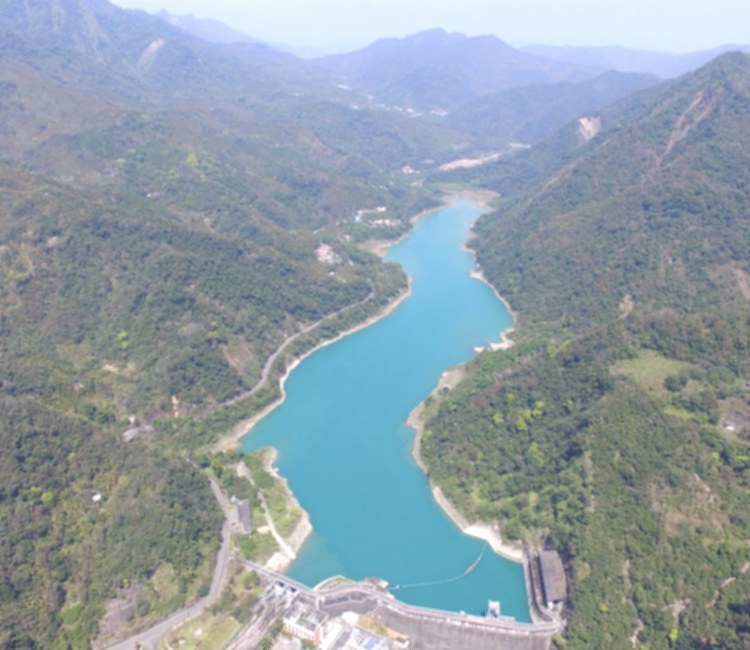
In 1918, the Civil Engineering Bureau of the Taiwan Governor-General's Office proposed the "Outline of the Sun Moon Lake Hydroelectric and Electrical Project." In July 1919, the Taiwan Governor-General's Office merged various public and private power plants, adopting a semi-public, semi-private management model to establish the Taiwan Electric Power Company. After its establishment, the Sun Moon Lake hydroelectric power project became the company's top priority.
The first phase of the project utilized the Nangang River at the foot of Guanyin Mountain on the western edge of the Puli Basin. A dam and pressure steel pipes were constructed, using a 50-meter drop to drive turbines to generate electricity for the overall power project. This was the Beishankeng Hydroelectric Power Plant (now the Beishan Unit of the Mingtan Power Plant).
In 1922, a 29.7-kilometer-long railway was laid between Ershui and Waichecheng (now Checheng Station) and the power plant site, Menpaitan (Neichecheng), to transport materials needed for the construction project. This is the present-day Jiji Line.
Following the end of World War I in 1918, raw material prices soared, and the Great Kanto Earthquake of 1923 triggered further economic panic. With no hope of securing funding, the project was suspended on December 1, 1923.
During this period, the railway used for the project (Jiji Line) was sold to the Taiwan Governor-General's Office for general transportation use. The proceeds from its operation were used to construct the Songshan Thermal Power Plant and the Kaohsiung Second Thermal Power Plant.
Construction resumed in 1930 after revisions. The revised plan involved drawing water from the Sisters Plain upstream of the Zhuoshui River to Wujie. A water diversion tunnel was built between the Zhuoshui River and Sun Moon Lake to implement the Wujie Water Diversion Project. After the tunnel was completed, the Zhuoshui River water flowed into Sun Moon Lake through the Dazhu Lake area on the southeast side of the lake. The third phase involved constructing earthen dikes at Shuishe and Toushe, raising the water level by 21 meters and significantly increasing the water volume of Sun Moon Lake, from which water was then diverted to the Shuili River.
On October 1, 1931, the final connection work commenced, dividing the entire civil engineering project into seven work zones, which were then contracted to construction companies such as Kajima Group, Obayashi Group, Okura Civil Engineering Co., Ltd., Imamichi Group, and Takashi Group for segmented construction.
Completed on June 30, 1934, the Sun Moon Lake power system provided ample and inexpensive electricity, thus accelerating Taiwan's industrialization. Especially from its completion in 1934 until the 1950s, the Sun Moon Lake power system accounted for over 70% of Taiwan's total electricity generation. Professor Lin Chung-hsiung of National Taiwan University once stated, "Without the power of Sun Moon Lake, Taiwan would not be what it is today."
In 1945, with the end of World War II and the arrival of the Nationalist government in Taiwan, Sun Yun-hsuan, then director of the Electrical and Electronic Engineering Department of the National Taiwan Electric Power Company, with the assistance of Japanese technicians, restored the power supply to the Sun Moon Lake First Power Plant on October 30, 1946, renaming it the Daguan Power Plant.